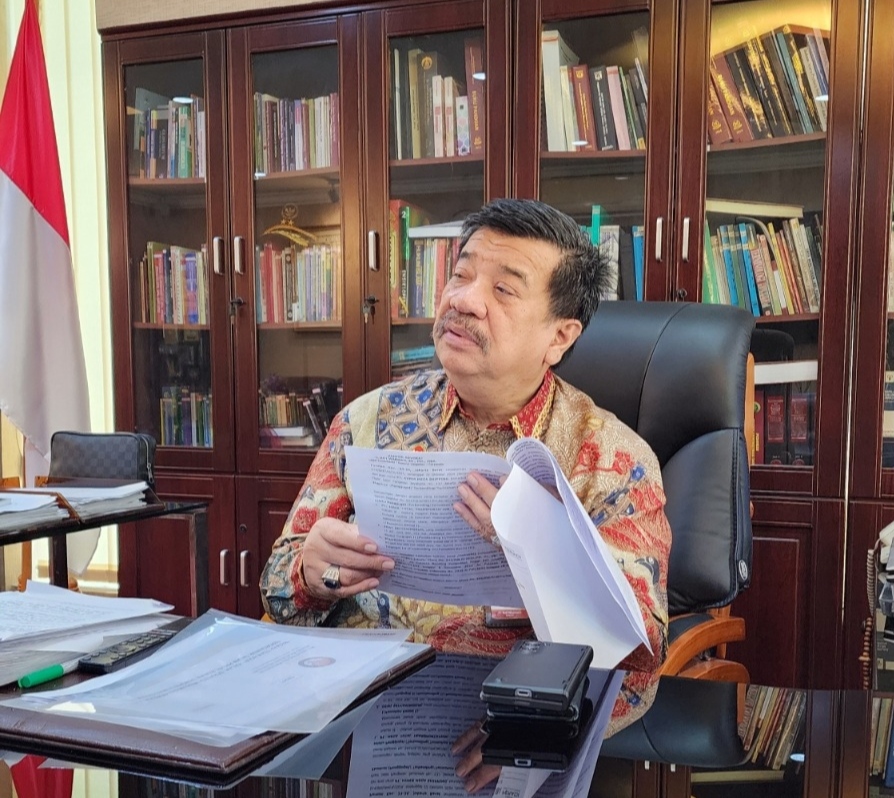












By: Dr. H. Adi Warman, S.H., M.H., M.B.A.
Corruptionnews.net, JAKARTA- Between Anti-Corruption Achievements, Due Process, and the Shadow of Case Brokers
Whenever information emerges about alleged case brokers within law enforcement institutions, including the Corruption Eradication Commission (KPK), the public usually splits into two extreme reactions. Some people immediately accept every allegation as the truth, while others reject it outright, fearing that such criticism could weaken the country’s anti-corruption institution.
Neither response is appropriate.
Unverified information should never be treated as fact. At the same time, allegations concerning the integrity of case handling should not be ignored merely to protect the institution’s image. In a state governed by the rule of law, an institution’s reputation is preserved not by silencing questions, but by having the courage to conduct transparent, objective, and accountable investigations.
The KPK is a vital institution for Indonesia and deserves to be protected. However, protecting the KPK does not mean justifying every action taken by those who work within it. Rather, it means ensuring that no one is able to trade the institution’s name, access, information, authority, or influence over the handling of cases for personal gain.
The KPK Is Still Working and Still Needed
It would be unfair to claim that the KPK is not functioning at all.
The law grants the KPK broad authority, including preventing corruption, coordinating and supervising anti-corruption efforts, conducting inquiries, investigations, prosecutions, and executing final court judgments. In carrying out these duties, the KPK is required to uphold the principles of legal certainty, transparency, accountability, public interest, proportionality, and respect for human rights.
Throughout 2025, the KPK reported that it had named 118 suspects and recovered approximately Rp1.53 trillion in state assets. These achievements demonstrate that its law enforcement and asset recovery functions continue to operate effectively. The KPK has also remained active in corruption prevention, coordination and supervision, anti-corruption education, gratuity control, and the management of public officials’ asset declarations.

Therefore, any assessment of the KPK should begin with the recognition that the institution continues to perform its duties and produce tangible results.
However, quantitative achievements should never be regarded as a blank check.
The number of suspects arrested, sting operations conducted, searches, seizures, prosecutions, or the value of recovered assets does not automatically prove that every legal process has been carried out properly.
Law enforcement is not merely about achieving results—it is equally about the process.
Even actions pursued with good intentions must be questioned if they disregard legal procedures, citizens’ rights, the sufficiency of evidence, conflicts of interest, or accountability in the exercise of authority
The Supervisory Board’s Assessment Is Not Entirely Satisfactory
The KPK Supervisory Board’s 2025 Annual Report presents a balanced assessment.
On one hand, the Chair of the Supervisory Board stated that the KPK had generally carried out its duties and authority well, although improvements were still needed in enforcement, prevention, and public education.
On the other hand, the same report concluded that the KPK’s performance in 2025 had not yet reached its full potential. Preventive efforts were considered largely routine and had not produced a significant impact on reducing corruption. Case handling remained focused on relatively small-scale cases and needed to be strengthened through better case-building strategies to address major corruption cases and achieve more substantial recovery of state losses.

The Supervisory Board also identified several internal issues, including prolonged investigations, blocked bank accounts that had not been formally unblocked, reports of alleged corruption that had not yet resulted in investigation orders, and insufficient compliance with internal regulations.
In addition, the Board noted delays in reporting searches and seizures. Compliance rates reached 90.1% for searches and 77.4% for seizures. While these figures do not automatically invalidate such legal actions, they indicate that administrative and procedural discipline has not yet been fully achieved. These findings should not be viewed as attacks on the KPK but rather as part of the internal oversight mechanism established by law.
Are There Many Case Brokers Within the KPK?
This question must be answered with caution.
Based on the official information currently available to the public, there is no sufficient evidence to conclude that there are “many” case brokers operating within the KPK. Such a claim is too broad unless it is supported by specific names, incidents, communication patterns, financial transactions, or concrete evidence of interference in case handling.
The KPK Supervisory Board reported receiving 22 complaints of alleged ethical violations throughout 2025. Of these, only one complaint was found to contain sufficient evidence to proceed to an ethics hearing in 2026, while the remaining 21 lacked adequate evidence. Moreover, not all of these complaints were related to case brokering. Therefore, these figures cannot be used to justify the conclusion that case brokers are widespread within the KPK.
Nevertheless, the absence of evidence proving that such practices are widespread does not mean the risk does not exist.
The KPK’s history has shown that influence peddling in the handling of legal cases has occurred before.
The case involving former KPK investigator Stepanus Robin Pattuju is one example that cannot be ignored. According to the official case findings, he received money in exchange for efforts to prevent an alleged corruption case involving the Tanjungbalai City Government from progressing from the inquiry stage to a formal investigation. In the same case, the investigator also introduced a lawyer to assist interested parties with their legal matters.
This case demonstrates that the risk of case brokering is not merely hypothetical. Such practices may emerge when the interests of parties involved in legal proceedings intersect with outside intermediaries and insiders who possess access to confidential information or influence over law enforcement processes.
In June 2026, the Chairperson of the KPK also emphasized that brokers or middlemen have little power unless they receive information or access from insiders. Although this statement was made in the broader context of bureaucracy and public procurement—and should not be interpreted as an admission that such practices are currently occurring within the KPK—it highlights an important principle: brokers can only operate when someone inside opens the door for them.

Distinguishing Between Case Brokers, Fraudsters, and Legitimate Professional Relationships
Not everyone who claims to have close connections with the KPK actually has access to the institution.
Some outsiders merely exploit the names of KPK leaders, investigators, prosecutors, or employees to obtain money. Such individuals may simply be fraudsters with no real connection to anyone inside the institution.
Others provide legitimate professional legal services, such as lawyers representing clients during investigations. These professional relationships should not automatically be regarded as case brokering, provided they are conducted transparently, under a valid power of attorney, do not promise particular outcomes, and do not involve trading influence over law enforcement officials.
A true case broker is different. A case broker offers or sells the ability to influence legal proceedings—for example, by promising that a case can be dismissed, delayed, accelerated, upgraded, downgraded, assigned to certain officials, or manipulated to produce a desired outcome.
Case brokers may also trade confidential information concerning planned summonses, searches, seizures, the designation of suspects, or other law enforcement actions.
Therefore, allegations of case brokering should only be taken seriously when supported by evidence, including:
* communications indicating promises to influence the handling of a case;
* requests for or receipt of money, goods, facilities, or other benefits;
* connections with individuals who possess authority or access to the case;
* unauthorized disclosure of confidential information;
* suspicious timing between payments or benefits and specific legal actions; and
* procedural changes or decisions that lack an objective explanation.
Without such evidence, allegations remain only suspicions. Conversely, once preliminary evidence exists, institutions should not dismiss accusations as mere rumors but must investigate them objectively.
Due Process Does Not Weaken the KPK
The KPK possesses extensive authority because corruption is an extraordinary crime that seriously harms the state. However, broad powers must always be accompanied by equally great responsibility.
The designation of suspects, arrests, detention, searches, seizures, the freezing of bank accounts, witness examinations, and prosecutions must all be carried out in accordance with the law. Every action must be supported by proper documentation, sufficient evidence, accurate administrative records, mechanisms for legal objections, and judicial oversight.
The KPK should never regard pretrial motions, lawsuits, ethical complaints, or public criticism as threats. Judicial review is not an insult to the institution; rather, it is a constitutional mechanism designed to ensure that public authority is exercised within the limits of the law.
If the KPK’s actions are declared lawful by the courts, judicial decisions strengthen the institution’s legitimacy. Conversely, if procedural errors are identified, those findings should serve as an opportunity for institutional improvement rather than being perceived as an attack on anti-corruption efforts.
The fight against corruption and the protection of human rights are not contradictory objectives. On the contrary, law enforcement that disregards due process can undermine public trust and provide corrupt individuals with grounds to challenge the legitimacy of the institution itself.
Cleaning from Within
To eliminate opportunities for case brokers, the KPK must undertake reforms that go beyond simply issuing integrity appeals.
First, every stage of case handling should be supported by a secure digital audit trail that cannot easily be altered. Access to documents, information, evidence, and case developments must be recorded, including who accessed the information, when it was accessed, what changes were made, and to whom the information was disclosed.
Second, the KPK should strengthen its conflict-of-interest screening mechanisms. Any employee who has family, personal, business, organizational, or professional relationships with parties connected to a case should disclose the conflict and withdraw from the case-handling process.
Third, positions that provide extensive access to confidential case information should be rotated periodically and systematically. Individuals who remain in the same strategic position for too long may develop networks that become difficult to monitor.
Fourth, the KPK and its Supervisory Board should establish a dedicated reporting mechanism for allegations of case brokering. Whistleblowers must be guaranteed confidentiality, protected against retaliation, and informed about the progress of their reports, provided such disclosure does not interfere with ongoing investigations.
Fifth, investigations should not stop with outside intermediaries offering illicit services. Whenever there are indications of insider involvement, investigators must examine communications, financial accounts, asset declarations, access to confidential information, personal relationships, and decision-making processes related to the case.
Sixth, investigation results should be disclosed in a balanced and proportionate manner. If allegations are proven, those responsible must be prosecuted without compromise. If allegations are unfounded, the institution should publicly clarify this to protect innocent individuals from ongoing speculation and reputational harm.
Transparency does not require revealing investigative strategies or confidential evidence to the public. Rather, it means providing adequate explanations regarding the investigative process, the basis for conclusions reached, and the institution’s accountability.
Protecting the KPK Through Responsible Criticism
Indonesia continues to need a strong, independent, professional, and courageous Corruption Eradication Commission (KPK)—one that is willing to pursue even the most powerful offenders.
However, the strength of the KPK should not be measured solely by the number of arrests it makes. Its true strength is also reflected in its willingness to investigate wrongdoing within its own institution, acknowledge and correct its mistakes, respect judicial decisions, improve its procedures, and remain open to public oversight.
The public also has a responsibility to act fairly. Criticism of the KPK should always be supported by credible facts and evidence. Spreading unfounded accusations can damage the reputation of innocent individuals and undermine the nation’s anti-corruption efforts.
Likewise, loyalty to an institution must never become an excuse to defend misconduct committed by individuals within it.
Supporting the KPK does not mean defending every person who works for the institution. Similarly, criticizing the KPK does not automatically mean weakening the fight against corruption.
To truly support the KPK is to ensure that its powers are exercised lawfully, professionally, proportionately, and free from personal interests. It also means ensuring that no outsiders exploit the institution’s name and that no insiders misuse their access or authority for personal gain.
At present, there is no conclusive evidence proving that there are widespread case brokers within the KPK. Nevertheless, past experience demonstrates that the risk is real and should never be underestimated.

Therefore, the appropriate response is neither to make reckless accusations nor to dismiss concerns defensively.
The proper response is to conduct objective investigations, trace financial transactions and communications, audit access to case information, protect whistleblowers, and take firm legal action against anyone proven to have traded influence or manipulated the administration of justice.
The KPK must be clean in order to clean others. An anti-corruption institution can remain strong only when its determination to prosecute corrupt individuals is matched by an equally strong commitment to uphold integrity within its own ranks.-**